The Addiction to Urgency (Part 1/2)
The Fine Line Between Driven and Drained
There's a word that gets thrown around in almost every organization I've worked with: high performing.
High performing teams. High performing individuals. High performing culture. High, higher, Highest. It shows up in OKRs (Objectives and Key Results, a goal-setting framework), in leadership offsites, in job postings, in quarterly reviews. Everyone wants it. Everyone measures something to prove they have it.
But what does it actually mean?
Because here's what nobody seems to talk about: the moment you give teams a label that sounds like a grade, you create a ranking. And rankings create losers. If one team is "high performing," the others are implicitly not. People start comparing. Managers start defending. Teams start performing for the label instead of for the work. What started as recognition quietly turns into pressure, competition, and the kind of toxicity that doesn't show up on a dashboard but poisons a culture from the inside.
In most organizations, "high performing" often translates to: fast output (and long hours), and the ability to absorb whatever gets thrown at you (without complaining or being able to say no). The team that delivered on a weekend. The department that shipped under emotional, psychological pressure. The people who stayed late, pulled through, made it happen. They get recognized. They get praised. And the system learns: this is what we reward.
But strip away the label and what's left? A normal team under abnormal pressure. There's nothing exceptional about delivering under stress. Anyone can sprint for a week. The label "high performing" just makes it sound like a virtue instead of what it usually is: a system that hasn't learned to plan sustainably.
Deep down we feel and know: this will cost us. But how much and who will pay that bill?
The Body Keeps the Score
(The phrase is borrowed from Bessel van der Kolk's research on how trauma and chronic stress physically manifest in the body. It's worth the read!)
So, there's a reason the crunch time feels "so good" in the moment of relief. It's not just willpower or team spirit. It's chemistry.
When you're under pressure, your body releases cortisol and adrenaline. Your focus sharpens. Your reaction time improves. You feel alert, productive, in the zone. Dopamine kicks in when you push through a deadline, when you deliver under pressure, when you get that "great job, team!" at the end of the sprint. Your brain registers it as a win. And it wants more.
But that's not motivation. That's a stress response being misread as performance.
A Harvard-trained psychologist described stress addiction as far more common than most people realize. The pattern is simple: the body gets used to operating in emergency mode, and over time it needs the emergency to function at all times. Without the pressure, you feel sluggish, restless, unproductive. So you look for the next fire. And that's not only in work environments, it follows you into your home, to your hobbies and free time.
The problem is what happens underneath. Chronic cortisol doesn't just make you tired. Studies show it physically shrinks the prefrontal cortex, the part of your brain responsible for decision-making, planning, and impulse control. Over time, the thing you need most to do your job well is the thing that's being eroded by the way you're doing your job.
And the dopamine system burns out too. What neuroscientists call an "anti-reward state": things that used to feel satisfying, a finished task, a shipped feature, a completed sprint, start feeling hollow. You did the work, but it doesn't register anymore. That's not laziness. That's your reward system running on empty.
Weekend Recovery or Weekend Survival?
Here's a question that tells you more than any performance metric: do you rest on your weekends, or do you catch your breath?
There's a difference. Resting means you recharge. You come back on Monday with energy. Catching your breath means you survive until Monday. You're not recovering, you're just pausing the emergency long enough to face the next one. You can often tell by the jokes in the room:
"Wish we had 2 days work and 5 days weekend haha!"
"Oh no, it's Monday again. Wasn't it just monday yesterday?"
And then there's the classic: the moment you go on vacation, you get sick. Your body held it together under pressure, running on adrenaline and cortisol, and the second it gets permission to stop, it collapses. That's not bad luck. That's a signal. Your immune system was suppressed the entire time you were "performing."
If any of this sounds familiar, you're not alone. But the system rarely reads these as warning signs. It reads them as commitment.
What the Navy SEALs Figured Out
Simon Sinek talks about a concept he learned while working with the U.S. Navy SEALs.
Performance meant technical skill, execution, output on the battlefield. Trust meant character off the battlefield.
"I may trust you with my life, but do I trust you with my money and my wife?"
The insight was uncomfortable: the high performer with low trust is the toxic team member. Narcissistic tendencies. Quick to blame. Puts themselves first. And the SEALs discovered they would rather have a medium performer with high trust than a top performer nobody trusts. Because skills can be trained. Character can't.
Sinek's observation for organizations concluded: we have a thousand metrics for performance and almost zero metrics for trust. We measure output, speed, delivery. We don't measure stability, reliability, or whether the team can actually depend on each other when it matters.
And consistency beats intensity. Most teams don't need spikes of brilliance. They need steady, reliable delivery over time. Intensity looks impressive in the moment. Consistency compounds. The team that delivers predictably every two weeks will outperform the team that crunches once a quarter and then collapses.
Hara Hachi Bu
There's a concept from Okinawa, Japan, called Hara Hachi Bu. It translates roughly to: eat until you're 80% full. Not 100%. Not stuffed. Just 80%.
The reason is biological. Your brain needs about 20 minutes to register that your stomach is full. If you eat until you feel 100% full, by the time the signal arrives, you're actually at 120%. And then comes dessert.
Okinawa by the way has the highest proportion of people over 100 years old in the world. About 50 per 100,000 residents. They don't eat less because they're disciplined. They eat less because they've built a system that accounts for the delay between action and feedback.
Now think about how teams are planned. Almost nobody plans at 80% capacity. The standard is 100%. Sometimes, most often 110-120%, with the quiet assumption that "the team will figure it out." And then an unplanned incident happens. A production bug. A stakeholder request. A colleague on sick leave. Suddenly you're at 130-150%. And nobody planned for that, because the system was already full.
The team that plans at 50-80% has room for reality. The team at 100% has room for nothing. But 80% feels "not enough." Just like 80% full doesn't feel "full enough." So we keep filling the plate at the buffet in fear of missing out on delivery.
And then we wonder why teams don't finish things. Why quality drops. Why people burn out. The answer is usually on your plate.
Honestly, ask yourself or anyone: Have you really ever reached a point of "you have not enough to do" — if a sprint planning or a quarter plan would just be cancelled, would the backlog (the team's prioritized list of upcoming work) really show nothing inside? Every team I know of answers with:
"We don't even have to look. We know of 50-100 things we should and could work on..."
Silence Can Be Loud
Organizations sometimes have "that one" content team we know of. They don't have dramatic releases. They don't stay late. They just deliver. Consistently. Predictably. Week after week. Year after year.
Nobody writes a LinkedIn post about them. Nobody gives them a special award at the all-hands meeting. They're not "high performing" in the way the system defines it, because the system defines performance as visible effort, not invisible stability.
But if you look at their output over six months, over a year, they've out delivered almost everyone around them. Not because they worked harder. Because they never had to recover from working "too hard". Their pace is sustainable. Their quality is consistent. The people stay. They respect their leaders. Fire alarm is the rare exception, not a rule.
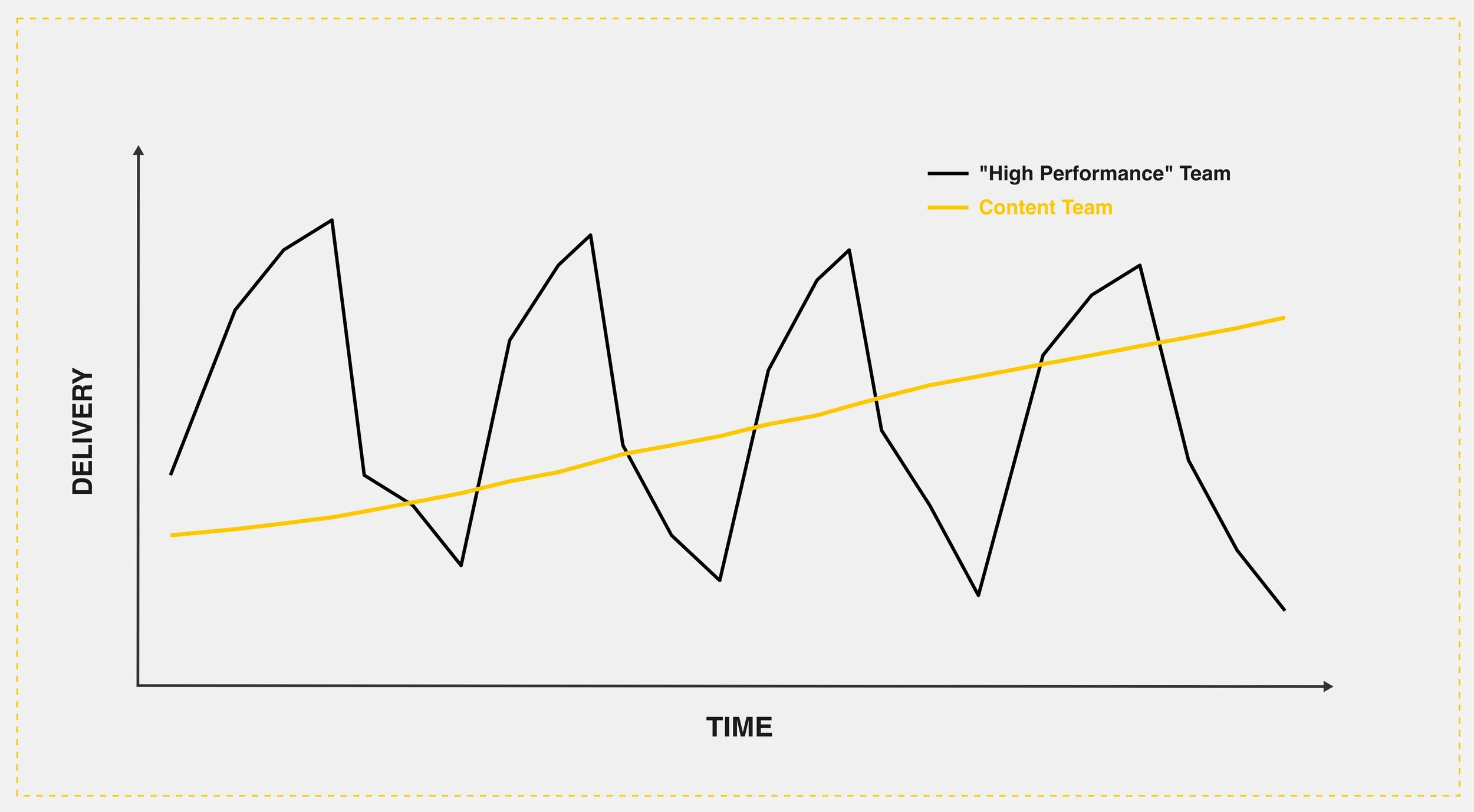
Intensity looks impressive. Consistency compounds.
That's a content team. Not "content" as in happy (though they often are). Content as in stable, grounded, continuously improving without burning fuel they don't have. They're not running at full speed. They're walking at a pace they can hold forever.
The question isn't whether high performance or content teams are "better." The question is: which one does your organization reward? And which one actually produces results over time?
The Self-predicting Prophecy
If you measure a team by how many fires they put out, you'll reward the team that's always on fire. If you measure by overtime hours, you'll reward the team that can't get things done during working hours. If you measure by heroic last-minute saves, you'll get a system that produces last-minute emergencies.
The scoreboard in most organizations is built for intensity, not consistency. It captures the dramatic moments and misses the quiet ones. And as long as that's the case, the system will keep producing what it measures: exhausted teams that look productive on a dashboard and fall apart behind the scenes. As old as it sounds: you will reap what you sow.
The most expensive decision isn't the fire. It's building a system that requires fires to feel productive.
So before you label your next team "high performing," ask yourself: performing for how long? At what cost? And what would happen if you stopped measuring the fire drills and started measuring who never needed one?
If you're wondering whether your team is performing or just surviving,-let's look at it together.
[ Book a free consultation call ]