The Red Line
When Everything Is Important…Nothing Is
In the original Kanban system, pioneered in Japanese production around 1940-1950, any worker on the factory floor could pull a red cord and bring the entire production line to a halt. Everyone would stop, come together, and focus on the problem until it was resolved. All hands on deck.
The idea was simple: if something is wrong, you don't keep producing around it. You stop and fix it. One problem at the start could lead to major production problems in the middle or end. So it was crucial to have it fixed. (Often, the Head of Production would even apologize to the worker that they are encountering an issue because it was their responsibility to not have that happen and ensure people where able to work.)
That principle made its way into modern Kanban as a swim lane on the board. The Red Line: reserved for exactly one thing. The item that needs to go through the system as fast as possible. Expedite. Critical. When a red card situation appears, it takes precedence over all standard work, and the team is expected to swarm that task until it's resolved. A WIP (work in progress) limit of 1. It exists to ensure faster, more reliable, and consistent service for the one thing that truly cannot wait. With every day it wasn't fixed, you would lose data, security, money, customers.
(Interestingly, the concept didn't transfer smoothly everywhere. In parts of the German automotive industry, stopping the line was read as failure rather than quality. Same tool, completely different effect depending on the culture it's placed in.)
Anyway — now, the Red Line only works if it's rare. The moment you put two things on it, it stops being a Red Line. Put five things on it, and you've just created another backlog. The concept self-destructs the moment "everything is urgent" becomes the norm.
I keep thinking about the Red Line when I look at how organizations handle priority. Because what I see, over and over is:
A system where everything sits on the Red Line.
The Invisible Portfolio
A while back, I was in a two-day offsite workshop for a group of managers at a larger company. Higher up, portfolio level. The people responsible for the organization's biggest projects. Tens of thousands of employees, multi-year timelines, strategic importance.
The goal of the workshop was straightforward: get all major projects on the table, understand their status, and agree on a priority for the current quarter.
That sounds like the kind of thing you'd assume happens regularly. Quarterly priorities. Status updates. A shared understanding of what matters most.
It didn't happen regularly, nor did it seem to happen with the purpose of common agreement. Not because they didn't care. But because the system had never created the space for it.
We started listing projects. Mostly from memory and conversations. Because there was no single place where all of this lived. A few brought spreadsheets with projects of their departments, hidden in an Excel sheet and only accessible for their department leads. Nonetheless, by the end of day 1, we managed to get an overview of the current active projects.
Every manager had been fighting for the same pool of resources. Competences, budgets, attention. But without a shared picture of what existed, those fights were happening on a personal level and political one. Priority was whatever landed on someone's desk with the most urgency circled on it. Or whomever raised their voice the loudest or had the best connections.
And of course: Everything is important!
Two Days of Honesty
Here's what struck me most about the starting point: the quarterly workshop wasn't even about their project status! Nobody walked in with an update on where things stood, how long they'd been running, or what was blocked and why it was blocked. The conversation was purely about priority, and even that was just declarations: "This is critical. No explanation. It just is!"
No data. No state. No impact communication. Just urgency claims.
The system had never asked for it, to put it bluntly. Priority had always been something you declared, not something you defended or had to justify.
So that became the task: no more shouting priorities into the room without backing them up. Even without solid data, the group agreed to work with what they had: rough states, approximate timelines, honest guesses. And build a shared picture from there. Not because it would be perfect, but because continuing without one wasn't an option anymore.
By the end of day two, there was a shared priority list. For one quarter. With full acknowledgment that the data underneath was rough, that the states were approximate, and that this was a starting point, not a finished plan.
It was some real progress. Not perfect. But honest and mostly agreed upon.
A Penny That Didn't Drop
And then, right at the end, one of the managers in the room said something along the lines of:
"Great, so let's schedule a session next week and do the same thing for Q3 projects!"
The room didn't push back, on the contrary. It almost sounded logical. We'd just built a process that worked, why not do it again immediately?
But it was mid-Q2 already ( one month left!) and the projects on that list had timelines measured in years, not weeks. We'd just spent two full days getting to a single quarter's priorities, without even having real data about what was happening inside those projects. And the immediate next thought was: let's plan the next quarter too. Before we've even started working with what we just created.
The system had just produced its first moment of transparency in who knows how long, and the immediate reflex was to skip past it and plan (or more, prioritize) the next things. Without any hint of understanding if the work in those projects would have made progress (since they didn't even know the current state!)
Prioritization without transparency doesn't produce clarity. It produces the urge to prioritize again. No actual data will lead to simple guessing and hoping for the best.
The System That Locks Up
Here's the thing that's uncomfortable to say out loud: when everything is equally important, even the best planning becomes pointless. How do you schedule everything for "now"? How do you allocate resources when every project is critical? You can't. The system locks up. Not because people aren't working hard, but because there's no basis for any decision. Without priority, there is no sequence. Without sequence, there is no focus. Without focus, nothing gets finished properly. It's like a restaurant kitchen where every order comes in marked as "rush." Nothing comes out faster. Everything comes out worse.
And it's uncomfortable. Because real prioritization isn't a ranking exercise (no matter the tool). It's a series of hard conversations that most organizations would rather avoid. No simple tool will remove the uncomfortable situation you need to go through.
At manager level, prioritization means deciding based on clear criteria, not gut feeling or political weight. It means being able to explain why project A comes before project B, and standing behind that decision when project B's stakeholder pushes back. Most organizations lack those criteria guidelines. Priority gets declared, not defended. "This is critical because I say so" isn't a guideline. It's a power move. And when every manager in the room plays that card, you end up with a list where everything is critical and nothing actually moves. And who will be blamed? Most often the teams.
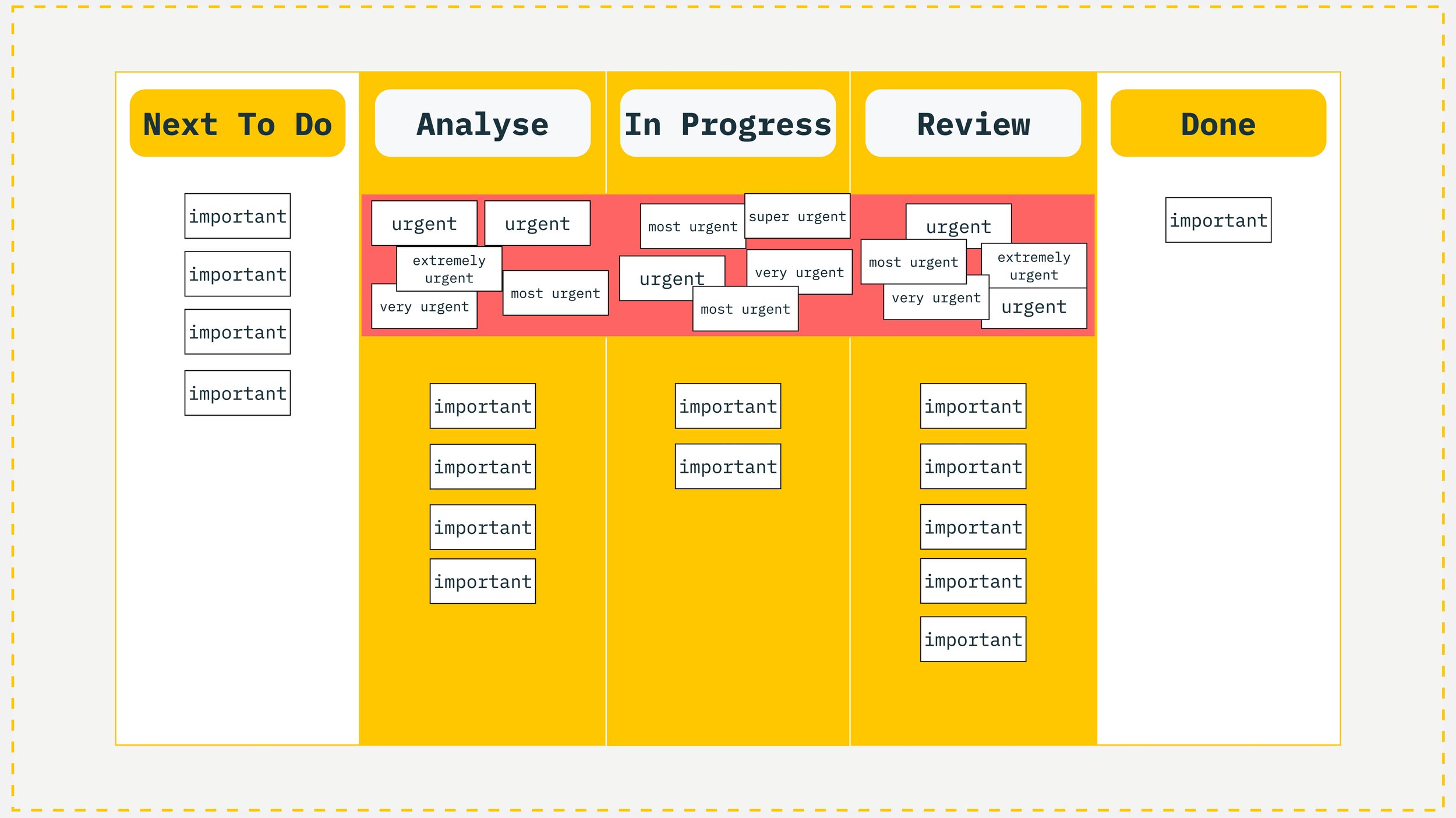
When everything sits on the Red Line, nothing moves through it.
At team level, prioritization means learning to say no. Or more precisely, learning to confront: "If we take this on now, what will be deprioritized?" That question is the one most teams never dare to ask, because the system doesn't reward it (or even punishes it). The system rewards saying yes, absorbing the new request, and figuring it out somehow (on people's health most often). But "figuring it out" usually means everything gets a little less focus, a little less quality, a little less thought. The team spreads thin, nothing gets delivered well, and the cycle repeats. Once the system has learned this behavior, it is very hard to break.
If you're on one of those teams: the one thing you can do is make the trade-off visible. Every time a new "urgent" request comes in, ask the question out loud: "If we take this on now, what stops?" You might not get to decide the answer. But you've made the cost visible. And that's a different conversation than absorbing it in silence.
And then there's the myth that "agile teams handle their own priorities," which gets used to avoid building a shared prioritization standard across levels. Portfolio keeps overriding. Teams keep absorbing. And the gap between both worlds never closes, because nobody owns the question: how do we actually decide what comes first?
The Art of Letting Go
Real prioritization isn't just about picking what comes first. It's a constraint. It forces the system to make a choice: this one thing, not that other thing. You need to pick. You can't have it all. And by making that choice explicit, it protects everything else from being interrupted by the next "urgent" request.
That's the hard part. Not the ranking. The letting go. Letting go means some projects won't happen this quarter, or maybe ever. Some might be a good idea but don't solve an actual need. They are ideas, not necessities. And some have been running so long that the only reason they're still alive is the investment already made. "We've put so much time and money into this, we have to finish it." That's the Sunk Cost Fallacy, and it's one of the strongest forces keeping dead priorities on the board. Letting go means telling a stakeholder: not now. Maybe not at all. And doing that requires something most organizations don't have: criteria that everyone agreed on before the conversation started. A backbone that's not willing to break. Managers who stick behind their team’s capabilities and don't want them to bleed out.
Organizations that treat everything as priority are running without that constraint. The result isn't speed. It's a system where nothing moves at the pace it should, because nothing has been given the space to. And blame-games are constant.
If your organization has more "top priorities" than it has teams to work on them, if every project is labeled critical but none of them finish on time, if the word "urgent" has lost all meaning because it's attached to everything — you don't have a prioritization problem. You have a criteria problem.
The Prerequisites of Priority
Before your next prioritization conversation, ask yourself: on what basis are we actually deciding?
Most organizations don't have clear criteria. Priority gets decided by urgency, by volume, by already confirmed budget, by whoever makes the strongest case in the room.
Urgency isn't a criterion. It's an emotion.
And "this is important because I say so" isn't a justification. It's a declaration.
Real prioritization needs standards that exist before the meeting starts. What's the actual impact or need behind this? What happens if we don't do it? Who is it for? What needs to go away before we even say yes? Those questions require bravery. And being brave is what every company needs, because every yes to something is a no to something else. That's not a flaw in the system. That's how priority works.
The Red Line works because it forces clarity: one thing, clear impact, obvious necessity. Everything else waits.
The question for your next session isn't "what's most important?"
It's: "Do we have the criteria to even answer that?"
If you don't, here's a starting point. Before the next prioritization conversation, try agreeing on these: Is there a legal, regulatory, or security obligation behind it? Does it respond to a market shift that won't wait for your roadmap? Does it protect the daily business that funds everything else on this list? What's the measurable impact if we don't do it — and who carries that cost? Those four questions won't solve everything. But they replace "because I say so" with something you can actually discuss.
And remember: the question of priority repeats. Daily business, weekly alignment, monthly direction. It's better to get used to it.
If you're not sure whether your organization has the criteria: that's the starting point. Let's map it out together. Book a free consultation call: